

Automatic Feeding Systems Market Set for Rapid Growth as Smart Livestock Technologies Transform Modern Farming 2026-2033
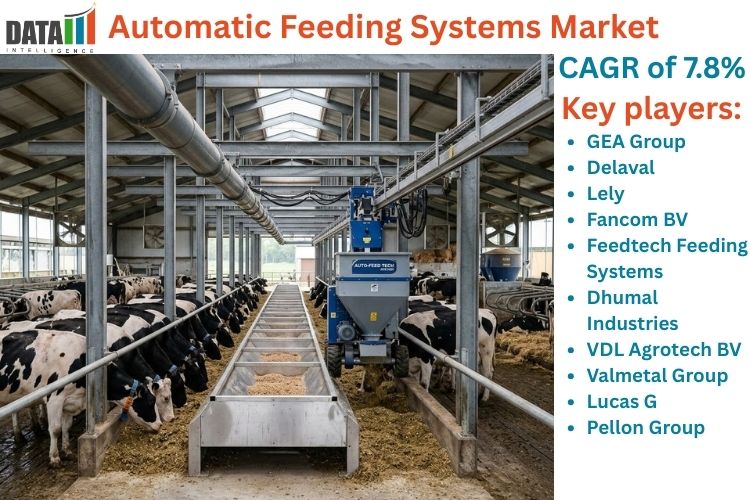
Automatic Feeding Systems Market
The Global Automatic Feeding Systems Market is expected to grow at a CAGR of 7.8% during the forecast period 2024-2031.
The Automatic Feeding Systems Market is expanding rapidly as farms adopt automation to boost efficiency, reduce labor dependency, and improve livestock nutrition management worldwide.”
AUSTIN, TX, UNITED STATES, March 9, 2026 /EINPresswire.com/ -- Market Overview:— DataM Intelligence
The Automatic Feeding Systems Market has been gaining significant momentum as livestock farms and aquaculture facilities increasingly adopt automated technologies to improve productivity, reduce labor dependency, and ensure precise feeding practices. Automatic feeding systems are designed to distribute feed to animals at controlled intervals and quantities, ensuring consistent nutrition while minimizing feed wastage. These systems are widely used across dairy farms, poultry farms, pig farms, and fish farming operations. Rising global demand for animal-based food products, combined with increasing farm sizes and the growing need for operational efficiency, is accelerating the adoption of automated feeding technologies. Modern feeding systems integrate sensors, data analytics, and smart controls, enabling farmers to monitor feed consumption and adjust feeding schedules in real time for improved animal health and productivity.
To Download Sample Report Here: https://www.datamintelligence.com/download-sample/automatic-feeding-systems-market
The Market is primarily driven by factors such as rising labor shortages in agriculture, increasing demand for dairy and meat products, and the rapid adoption of smart farming technologies. Among system types, conveyor feeding systems and robotic feeding systems hold a major share due to their efficiency in large-scale farms. Geographically, Europe leads the market owing to its highly advanced dairy farming infrastructure, early adoption of automation technologies, and strong government support for precision agriculture. Meanwhile, Asia-Pacific is emerging as a rapidly growing region due to the expansion of livestock production and modernization of farming practices.
Key Highlights from the Report:
The Automatic Feeding Systems Market is projected to reach US$ 12.8 billion by 2032, driven by rapid automation in livestock farming.
Growing global demand for dairy products, meat, and aquaculture output is accelerating the adoption of automated feeding solutions.
Robotic feeding systems are gaining popularity due to their ability to optimize feed distribution and reduce labor costs.
Europe currently dominates the market, supported by technologically advanced dairy farms and strong agricultural automation initiatives.
Increasing integration of IoT, sensors, and data analytics in feeding systems is enhancing operational efficiency and livestock monitoring.
The Asia-Pacific region is expected to witness the fastest growth due to expanding livestock production and farm modernization.
Market Segmentation:
The Automatic Feeding Systems Market can be segmented based on system type, livestock type, and application. By system type, the market includes rail-guided feeding systems, conveyor feeding systems, robotic feeding systems, and self-propelled feeding systems. Conveyor feeding systems are widely used due to their reliability and ability to distribute feed efficiently across large barns or poultry houses. Robotic feeding systems are gaining traction as they offer automated mixing, distribution, and monitoring capabilities, enabling farmers to optimize feed utilization and reduce manual intervention. Self-propelled feeding systems are also increasingly adopted in large dairy farms, where continuous feeding is required to maintain high productivity.
In terms of livestock type, the market is categorized into dairy cattle, poultry, swine, aquaculture, and others. The dairy cattle segment holds a substantial share due to the increasing adoption of automated feeding technologies in large dairy farms to improve milk production efficiency. Poultry farms are also adopting automated feeding systems to ensure uniform feed distribution and improve bird growth rates. Additionally, aquaculture operations are increasingly integrating automated feeding solutions to ensure optimal feeding schedules, reduce feed wastage, and maintain water quality.
Based on application, the market includes farms, livestock research centers, and aquaculture facilities. Commercial farms represent the largest segment as farmers invest in automation to manage large herds and flocks efficiently. Research institutions are also adopting advanced feeding systems to monitor animal behavior and nutrition patterns in controlled environments.
Speak to Our Analyst and Get Customization in the report as per your requirements: https://www.datamintelligence.com/download-sample/updated/automatic-feeding-systems-market
Regional Insights:
Europe dominates the Automatic Feeding Systems Market due to its well-established livestock industry and high adoption of precision farming technologies. Countries such as the Netherlands, Germany, and Denmark have a strong presence of automated dairy farms that utilize robotic feeding and milking systems. Government policies encouraging sustainable agriculture and efficient farm management have further accelerated the adoption of automated feeding solutions in the region.
North America represents another significant market driven by large-scale livestock operations and increasing adoption of smart farming technologies. The United States and Canada have witnessed growing investments in farm automation to address labor shortages and improve operational efficiency. Additionally, the presence of leading agricultural technology companies has supported innovation and adoption of advanced feeding systems.
The Asia-Pacific region is expected to experience the fastest growth in the coming years. Countries such as China, India, and Japan are expanding their livestock production capacities to meet rising demand for animal protein. Increasing awareness among farmers regarding feed efficiency and livestock productivity is driving the adoption of automated feeding systems. Government initiatives supporting agricultural modernization and farm mechanization are also contributing to market growth.
Latin America and the Middle East & Africa are gradually adopting automated feeding systems, particularly in large poultry and dairy operations. As commercial livestock farming expands in these regions, the demand for automated solutions is expected to increase steadily.
Market Dynamics:
Market Drivers
One of the primary drivers of the Automatic Feeding Systems Market is the increasing global demand for animal-based food products, including dairy, meat, and fish. As the global population continues to grow, livestock producers must increase productivity while maintaining efficiency and sustainability. Automated feeding systems enable farmers to deliver precise feed quantities at optimal intervals, improving feed conversion ratios and overall animal health. Another major driver is the rising labor shortage in the agricultural sector. Manual feeding is labor-intensive and time-consuming, making automation an attractive solution for farmers seeking to reduce operational costs and improve efficiency.
Market Restraints
Despite its advantages, the market faces certain challenges that may limit adoption. The high initial investment cost associated with automated feeding equipment is a major barrier, especially for small and medium-scale farmers. Installation, maintenance, and system integration expenses can be substantial, discouraging adoption in cost-sensitive regions. Additionally, the lack of technical expertise among farmers in developing regions may hinder the effective implementation and operation of advanced feeding technologies.
Market Opportunities
The market presents numerous opportunities as smart farming and precision agriculture technologies continue to evolve. Integration of artificial intelligence, IoT-enabled sensors, and real-time monitoring systems can significantly enhance feeding efficiency and livestock management. Automated systems capable of analyzing feed consumption patterns and animal health data can help farmers make informed decisions to optimize productivity. Furthermore, increasing investments in sustainable agriculture and livestock management are expected to create new growth opportunities for manufacturers of automated feeding systems.
Looking For Full Report? Get it Here: https://www.datamintelligence.com/buy-now-page?report=automatic-feeding-systems-market
Frequently Asked Questions (FAQs):
How big is the Automatic Feeding Systems Market globally?
What is the projected growth rate of the Automatic Feeding Systems Market during the forecast period?
Who are the key players operating in the Automatic Feeding Systems Market?
What factors are driving the growth of the automatic livestock feeding systems industry?
Which region is expected to dominate the Automatic Feeding Systems Market through 2032?
Company Insights:
Several companies are actively operating in the Automatic Feeding Systems Market, focusing on technological innovation and strategic partnerships to strengthen their market presence.
GEA Group
Delaval
Lely
Fancom BV
Feedtech Feeding Systems
Dhumal Industries
VDL Agrotech BV
Valmetal Group
Lucas G
Pellon Group
Recent Developments:
United States:
December 2025: USA solidified its global market leadership with a projected CAGR of 19.2% through 2035, driven by acute agricultural labor shortages and rapid adoption in key dairy states like Wisconsin and California. Large-scale commercial farms accelerated automated feeding implementations to boost efficiency amid consolidation trends.
November 2025: The U.S. market showed strong growth potential at a 23.5% CAGR from 2025 onward, fueled by high labor costs, AI-based livestock platforms, and stricter animal welfare regulations. Investments in precision feeding tech rose to meet retailer sustainability demands.
October 2025: Major automation vendors expanded AI-integrated systems in response to evolving traceability standards, enhancing production in regions like New York and Pennsylvania.
Japan:
January 2026: The Automatic Feeding System for Sows market surged with over 35% adoption in commercial swine farming, supported by IoT analytics, labor shortages, and government subsidies for precision farming. Demand shifted to modular systems with AI-driven feed optimization.
December 2025: Japan's market emphasized workforce constraints and aging demographics, with a 16.4% CAGR through 2035 via intelligent management platforms for sustainable livestock operations. Advanced infrastructure drove integration with existing farms.
November 2025: Fully automatic flexible feeding systems advanced with AI for dynamic adjustments and anomaly detection, aligning with Industry 4.0 policies on energy efficiency and cybersecurity. Early adoption positioned manufacturers for customized production gains.
Unlock 360° Market Intelligence with DataM Subscription Services: https://www.datamintelligence.com/reports-subscription
Conclusion:
The Automatic Feeding Systems Market is poised for significant growth as the agriculture and livestock sectors continue to embrace automation and smart farming technologies. Rising global demand for animal protein, labor shortages, and the need for efficient feed management are key factors driving the adoption of automated feeding systems. While high initial costs remain a challenge, advancements in technology and increasing awareness among farmers are expected to accelerate market penetration. With Europe leading the market and Asia-Pacific emerging as a fast-growing region, the future of automated feeding technologies appears promising as farms worldwide move toward more efficient and sustainable livestock management practices.
Related Reports:
Aquaculture Feed Extrusion Market
Feed Software Market
Sai Kiran
DataM Intelligence 4Market Research
877-441-4866
Sai.k@datamintelligence.com
Visit us on social media:
LinkedIn
X
Legal Disclaimer:
EIN Presswire provides this news content "as is" without warranty of any kind. We do not accept any responsibility or liability for the accuracy, content, images, videos, licenses, completeness, legality, or reliability of the information contained in this article. If you have any complaints or copyright issues related to this article, kindly contact the author above.
