

Drainage System Market to Nearly Double to USD 5.94 Billion by 2035 as Smart Surgery and Infection Control Drive Growth
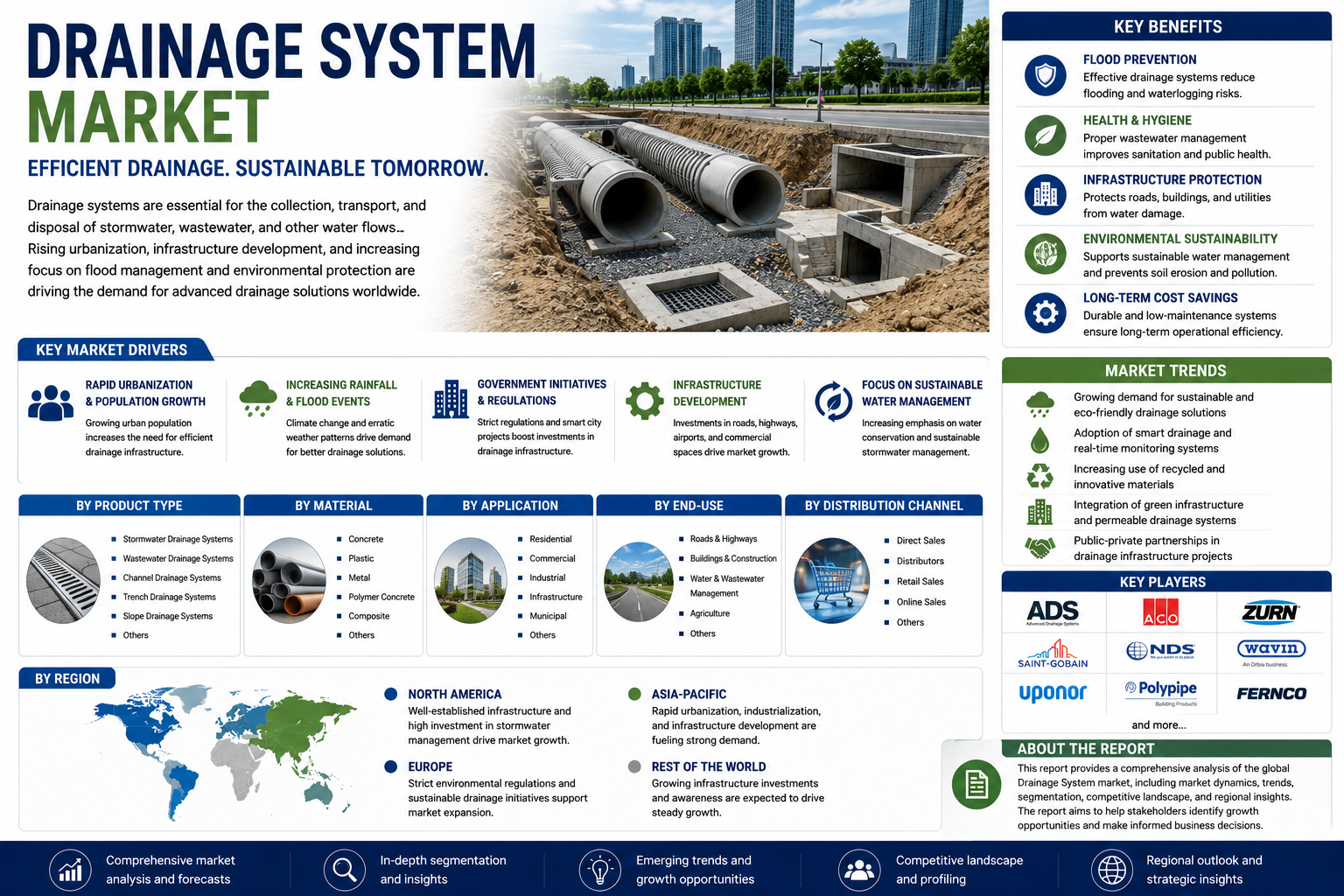
Drainage System Market
Asia-Pacific is projected to expand at an 8.9% CAGR, the fastest of any region, through 2035.
GA, UNITED STATES, July 8, 2026 /EINPresswire.com/ -- Beneath the visible drama of the operating room lies a quieter but equally critical technology: the drainage system. Every thoracotomy, every joint replacement, every neurosurgical intervention generates fluid that must be evacuated precisely, safely, and without introducing infection. As surgical volumes surge globally and infection-prevention standards tighten, the humble drainage tube has evolved into a sophisticated medical device ecosystem. According to a comprehensive report by Market Research Future (MRFR), the global drainage system market reached an estimated USD 3.02 billion in 2025 and is projected to grow from USD 3.23 billion in 2026 to USD 5.94 billion by 2035, advancing at a compound annual growth rate of 7.0%. Two catalysts underpin this expansion: rising global surgical volumes driven by aging populations and chronic disease burdens, and infection-prevention mandates that are compelling hospitals to upgrade legacy open drainage configurations to closed, antimicrobial-coated alternatives.The Surgical Volume Surge: A Structural Tailwind
The World Health Organization estimates that the number of major surgical procedures performed annually will exceed 380 million by 2030, up from roughly 310 million in 2022. Each incremental procedure involving a body cavity, joint space, or wound bed creates a discrete demand occasion for drainage. Cardiovascular and orthopedic specialties—which together account for nearly half of all drainage utilization—are expanding particularly fast in middle-income economies where cardiac catheterization labs and arthroplasty programs are scaling rapidly.
This volume effect is the single largest structural tailwind for the drainage system market. The OECD recorded a 6.1% annual increase in knee replacements across member nations between 2019 and 2024, and the global rise in hip and knee arthroplasty volumes is propelling orthopedic applications to an 8.2% CAGR, the fastest among all surgical applications. Thoracic and cardiovascular procedures remain the largest application segment at 32% of revenue, because chest-tube drainage is clinically mandatory following virtually all open-heart, lung-resection, and pleural-intervention surgeries.
Infection Control: From Recommendation to Mandate
The regulatory environment surrounding drainage systems has shifted decisively toward infection prevention. The U.S. Centers for Disease Control and Prevention's 2024 update to Surgical Site Infection (SSI) prevention guidelines explicitly recommends closed-suction drainage over open systems for high-risk cavity procedures, accelerating hospital procurement upgrades across the United States. Clinical meta-analyses show closed-suction systems reduce surgical site infection rates by 25–35% compared to open-gravity alternatives across abdominal and thoracic indications—evidence that is reshaping purchasing behavior.
Download Report Sample Copy with TOC: https://www.marketresearchfuture.com/sample_request/31048
In Europe, the EU Medical Device Regulation (EU MDR 2017/745) imposes stricter biocompatibility and traceability requirements that favor premium closed-system designs. Compliance deadlines running through 2028 are compelling European hospitals to replace legacy devices, generating a concentrated procurement wave. Silver-ion and chlorhexidine antimicrobial coatings now appear in roughly 18% of premium drainage products, creating a clinical-evidence moat that commodity manufacturers struggle to replicate. Cardinal Health's expanded surgical drainage accessories line, launched in November 2024 with an antimicrobial-coated connector series, is designed to reduce catheter-associated infections by up to 30%.
The Technology Shift: From Passive Gravity to Active Intelligence
The drainage system market is undergoing a technology transformation that mirrors broader trends in connected healthcare. Legacy gravity-dependent passive collection is giving way to electronically regulated active suction platforms that feed real-time output data directly into electronic health records—a capability that legacy jar-and-tube setups cannot provide.
Active drains held a 64% share of the market in 2024, reflecting clinician preference for controlled negative-pressure evacuation. These systems offer regulated suction pressure that accelerates fluid evacuation and reduces dead-space formation. Hospitals in high-income countries have largely standardized on active drain protocols for thoracic, abdominal, and orthopedic indications.
The next frontier is smart drainage platforms with IoT connectivity. The convergence of miniaturized pressure sensors, low-energy Bluetooth modules, and cloud-based analytics creates opportunities for "smart" drainage systems that transmit fluid volume, color, and flow-rate data to clinical dashboards in real time. Early-stage pilot programs at three U.S. academic medical centers reported a 22% reduction in unplanned drain removals when clinicians received automated alert notifications. Medela AG launched a Bluetooth-enabled chest drainage platform in March 2025, targeting ICU adoption in U.S. and German academic medical centers.
Artificial intelligence is entering the drainage workflow. AI algorithms trained on large drainage-output datasets will increasingly guide clinician decisions on drain removal timing, reducing both premature removals (which risk fluid re-accumulation) and prolonged placements (which elevate infection risk). Early clinical trials at Johns Hopkins and Charité Berlin suggest AI-guided protocols can shorten average drain-in-situ time by 18–24 hours without increasing complication rates.
The Ambulatory Surgery Revolution
The decentralization of surgical care is reshaping product demand. The United States added over 900 new Medicare-certified ambulatory surgery centers (ASCs) between 2020 and 2024, bringing the national total past 6,100. The International Association for Ambulatory Surgery projects that 75% of elective surgical procedures in high-income countries will occur in outpatient or day-surgery settings by 2032. This shift favors compact, patient-intuitive drainage products over bulky wall-mounted hospital systems.
ASCs performing same-day thoracoscopic, laparoscopic, and arthroscopic procedures require compact, portable drainage devices optimized for rapid patient turnover. This setting disproportionately favors single-use, pre-assembled drainage kits over reusable hospital-grade systems, pushing the accessories segment to a 10.1% CAGR—the fastest growth rate in the market. ConvaTec acquired a U.S.-based wound drainage startup in May 2024, specializing in portable closed-suction devices for outpatient surgical settings, precisely to capture this trend.
Purchase Now: https://www.marketresearchfuture.com/checkout?currency=one_user-USD&report_id=31048
Regional Dynamics: North America Leads, Asia-Pacific Surges
North America commands roughly 40% of global revenue, anchored by high procedural reimbursement rates and a dense ambulatory surgery center network. The United States alone accounts for approximately 82% of regional revenue, with outpatient surgical volume growing 4.3% annually between 2021 and 2024. Canada's federal government committed CAD 2 billion to surgical backlog reduction in 2023, funneling capital toward consumable procurement.
Europe holds the second-largest share at approximately 27%, supported by stringent EU MDR compliance standards that favor premium device adoption. Germany leads with roughly 24% of regional revenue, backed by robust medtech procurement budgets. The UK's NHS Elective Recovery Plan, backed by GBP 8 billion in ring-fenced funding, is generating a sustained procurement wave for surgical supplies including drainage devices.
Asia-Pacific is the fastest-growing region with a projected CAGR of 8.9%, fueled by government-backed hospital construction in India and China. China's National Health Commission approved construction of 1,400 new county-level hospitals between 2023 and 2027, each requiring full surgical-suite outfitting. India's Ayushman Bharat program now covers over 600 million citizens for secondary and tertiary surgical procedures, expanding the addressable patient pool at the district-hospital level. India's National Health Mission earmarked approximately USD 4.4 billion for district hospital upgrades between 2024 and 2028.
South America and the Middle East & Africa are smaller but growing markets. Brazil's Unified Health System serves over 160 million citizens, making federal procurement tenders the primary commercial channel. Saudi Arabia's Vision 2030 healthcare pillar includes the construction of 38 new hospitals, generating multi-year consumable supply contracts.
Product and Segment Landscape
Drainage systems—encompassing both open gravitational and closed-suction configurations—accounted for 63% of revenue in 2024, reflecting their non-discretionary role in surgical workflows. Accessories, including tubing extensions, graduated collection canisters, and antimicrobial connector caps, are the fastest-growing segment at a 10.1% CAGR, generating recurring revenue that grows in proportion to the installed device base.
By type, active drains dominate at 64% share, while passive drains persist in emerging-market settings where device budgets are constrained. By end user, hospitals represented 77% of spending in 2024, but ambulatory surgical centers and clinics are the fastest-growing category at a 7.5% CAGR, reflecting the outpatient surgery migration.
Headwinds: Cost, Sustainability, and Clinical Evolution
The drainage system market faces meaningful challenges. Price sensitivity in emerging markets limits penetration of advanced technologies. Public hospitals across Sub-Saharan Africa and South Asia operate under per-procedure consumable budgets as low as USD 8–12 for drainage supplies—roughly one-fifth of the average unit cost in the United States.
Single-use plastics regulations are tightening, particularly in Europe. The European Commission's revised Packaging and Packaging Waste Regulation, expected to take full effect by 2030, imposes extended-producer-responsibility fees on single-use medical plastics, including PVC drainage tubing and polycarbonate collection canisters. Manufacturers face the choice of absorbing fee-related cost increases of 4–7% or redesigning products with recyclable polymers.
Reimbursement compression in North America and the clinical shift toward drain-free protocols under Enhanced Recovery After Surgery (ERAS) guidelines present additional headwinds. ERAS protocols now adopted by over 2,800 hospitals globally recommend avoiding prophylactic drainage in select procedures. While this removes low-acuity demand, it simultaneously concentrates remaining utilization on higher-complexity cases requiring advanced active systems—partially offsetting volume loss with richer product mix.
Emerging Opportunities: Sustainability, Data Monetization, and Home Care
Looking ahead, several trends could reshape the drainage system market. Sustainable and recyclable drainage device design is gaining regulatory momentum. By 2030, procurement frameworks in at least 15 OECD countries are expected to embed lifecycle carbon scoring into tender evaluation criteria, pushing the market toward bio-polymer materials and reusable-component architectures.
Data monetization through outcome analytics represents a novel revenue stream. Aggregated, de-identified drainage output data—volume trends, complication flags, and fluid biomarker correlations—hold value for clinical registries, pharmaceutical post-market surveillance studies, and health-economics research organizations.
Outpatient and home-care drainage kits are an underserved niche. As same-day discharge rates climb, demand is building for compact, patient-managed drainage kits designed for home use with telehealth monitoring integration. Companies that bundle user-friendly devices with instructional digital content can unlock revenue outside traditional hospital channels.
Platform economics and bundled surgical consumable contracts are reshaping competitive dynamics. Hospital group purchasing organizations are shifting toward consolidated "surgical bundle" contracts that package drainage devices with wound-closure, hemostasis, and infection-barrier products under single-vendor agreements. This rewards manufacturers with broad surgical consumable portfolios and penalizes single-category specialists, likely accelerating M&A activity.
Read More: https://www.marketresearchfuture.com/reports/drainage-system-market-31048
Competitive Landscape
The drainage system market exhibits moderate concentration, with the top five players holding an estimated 35–42% revenue share and a Herfindahl-Hirschman Index of 800–1,100. Major players include Medela AG, Cardinal Health, B. Braun Melsungen AG, ConvaTec Group PLC, Stryker Corporation, Ethicon (Johnson & Johnson), Cook Medical, Teleflex Incorporated, Becton Dickinson and Company, and Redax S.p.A.
Medela leads with an estimated 8–11% revenue share, distinguished by its premium innovation in thoracic drainage and its Bluetooth-enabled connected platform. Cardinal Health leverages scale-driven distribution and group purchasing organization relationships. B. Braun's EUR 120 million investment in a new Malaysian manufacturing facility signals commitment to Asia-Pacific growth. Stryker specializes in orthopedic drainage with bundled implant contracts, while Ethicon cross-sells through Johnson & Johnson's broad surgical consumable portfolio.
Related Report
Natural Stone Market https://www.marketresearchfuture.com/reports/natural-stone-market-25839
India Rigid Plastic Packaging Market https://www.marketresearchfuture.com/reports/india-rigid-plastic-packaging-market-20707
corrugated automotive packaging market https://www.marketresearchfuture.com/reports/corrugated-automotive-packaging-market-31670
Smart Retail Packaging Market https://www.marketresearchfuture.com/reports/smart-retail-packaging-market-11501
Brick Carton Packaging Market https://www.marketresearchfuture.com/reports/brick-carton-packaging-market-11846
active modified atmospheric packaging market https://www.marketresearchfuture.com/reports/active-modified-atmospheric-packaging-market-34236
Market Research Future
Market Research Future
+1 855-661-4441
email us here
Legal Disclaimer:
EIN Presswire provides this news content "as is" without warranty of any kind. We do not accept any responsibility or liability for the accuracy, content, images, videos, licenses, completeness, legality, or reliability of the information contained in this article. If you have any complaints or copyright issues related to this article, kindly contact the author above.
