

Small Arms Market to Reach US$ 17.58 Billion by 2035, Amid Rising Defense Modernization and Civilian Demand
Small Arms Market.
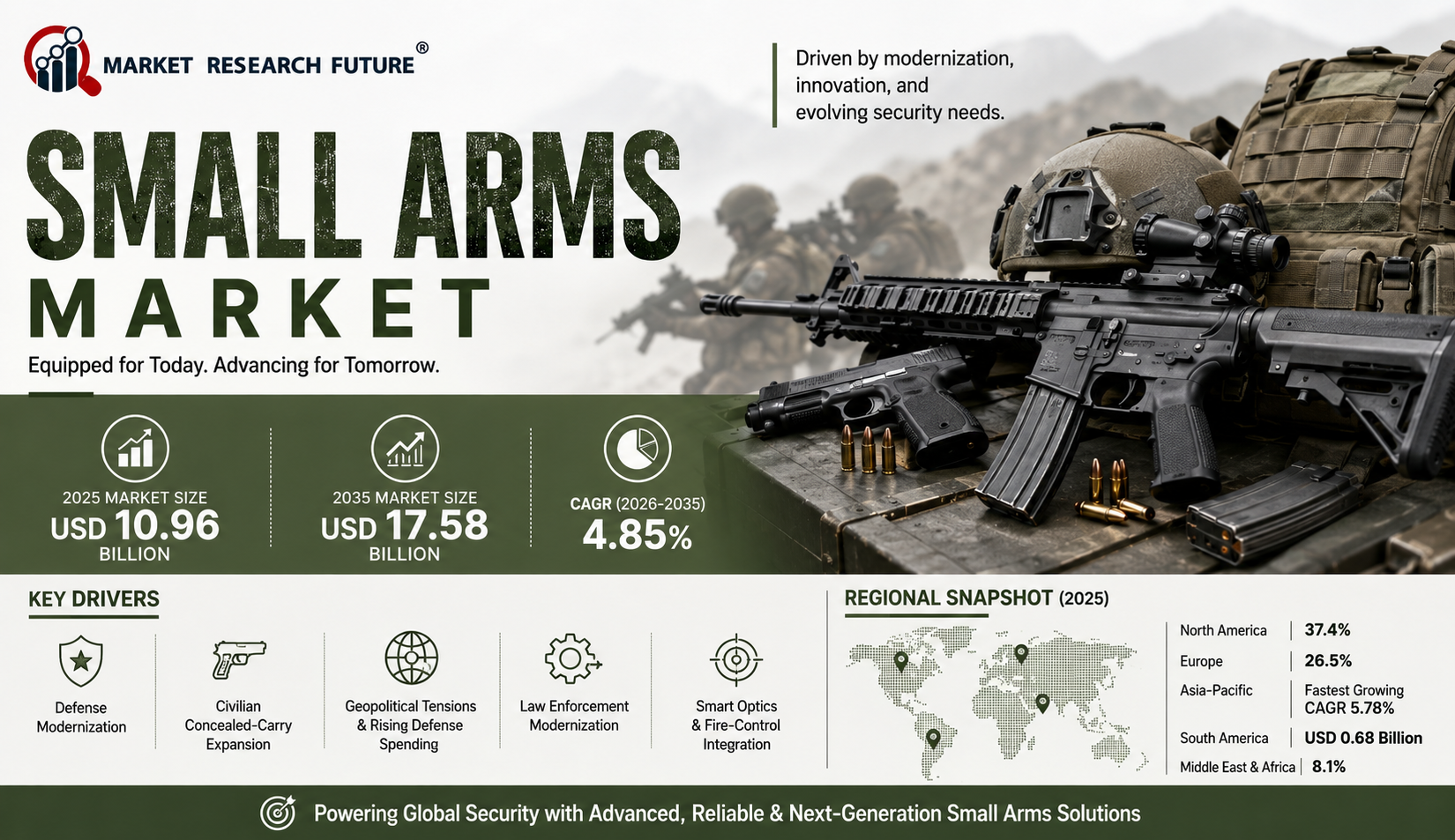
Market valued at USD 10.96 billion in 2025, is projected to reach USD 17.58 billion by 2035, registering a CAGR of 4.85% during the forecast period 2026–2035.
NEW YORK, NY, UNITED STATES, July 20, 2026 /EINPresswire.com/ -- The global Small Arms Market is poised for steady expansion over the next decade, supported by increasing defense modernization initiatives, evolving law enforcement requirements, and sustained civilian demand across key regions.Small arms, which include pistols, revolvers, rifles, carbines, and machine guns, remain essential to modern defense and security frameworks. While historically considered a mature industry, the sector is undergoing a transformation driven by technological integration, modular weapon design, and changes in procurement strategies. These developments are reshaping the market landscape, enabling manufacturers to move beyond traditional volume-based growth toward higher-value, technology-driven offerings.
The increasing adoption of modular weapon systems, integration of smart optics, and the shift toward lifecycle-based procurement models are collectively enhancing the revenue potential of the market. Additionally, geopolitical uncertainties and regional conflicts continue to underscore the importance of maintaining well-equipped armed forces, further reinforcing demand for advanced small arms systems.
Request Sample of Report: https://www.marketresearchfuture.com/sample_request/7202
Market Drivers:
The growth of the Small Arms Market is strongly influenced by a combination of structural, geopolitical, and technological drivers, each contributing to the overall CAGR in varying degrees.
Defense Modernization and Squad Weapon Programs (22–26% Impact)
Long-term defense modernization initiatives remain the most significant growth driver. Countries in North America and Europe are investing heavily in next-generation infantry weapons to replace legacy systems. These programs typically span multiple years, ensuring sustained procurement and consistent demand. The focus is on enhancing soldier lethality, accuracy, and operational efficiency through advanced weapon platforms.
Civilian Concealed-Carry Legislation Expansion (16–20% Impact)
Short-term growth in the market is significantly influenced by the expansion of concealed-carry laws, particularly in North America. This has led to increased adoption of handguns among civilians for personal defense. The trend has also encouraged new entrants into the market, contributing to higher sales volumes and diversification of product offerings.
Geopolitical Tensions and Defense Spending (14–18% Impact)
Rising geopolitical tensions and territorial disputes across Europe and Asia-Pacific are driving increased defense budgets. Governments are prioritizing military readiness, leading to higher procurement of small arms for infantry units. This driver operates over a medium-term horizon and is expected to remain a critical factor influencing market growth.
Domestic Defense Manufacturing Corridors (12–15% Impact)
Emerging economies, particularly in Asia-Pacific, are focusing on developing domestic defense manufacturing capabilities. This reduces dependence on imports and strengthens national security. The establishment of defense corridors and local production facilities is creating new opportunities for both domestic and international players.
Law Enforcement Fleet Modernization (8–11% Impact)
Law enforcement agencies worldwide are upgrading outdated firearms to modern, high-performance systems. The emphasis is on improving ergonomics, safety features, and operational efficiency. This driver contributes to steady short-term demand across global markets.
Smart Optics and Fire-Control Integration (7–10% Impact)
The integration of advanced optics and digital fire-control systems is enhancing weapon capabilities. These technologies improve targeting accuracy and operational effectiveness, making them highly attractive to military and law enforcement agencies.
Ammunition Standardization (5–8% Impact)
Standardization initiatives, particularly within NATO, are facilitating interoperability among allied forces. This simplifies logistics and enables bulk procurement, supporting long-term market growth.
Market Opportunities:
The Small Arms Market presents several high-potential opportunities that are expected to shape its future trajectory.
Modular Weapon Platform Standardization
The adoption of modular weapon systems is gaining momentum among military forces. These platforms allow for quick configuration changes, enabling a single weapon to perform multiple roles. This not only reduces logistical complexity but also creates ongoing demand for accessories and upgrades, generating recurring revenue streams for manufacturers.
Smart Optics and Networked Fire-Control Systems
The integration of advanced targeting technologies represents a high-margin growth opportunity. Systems incorporating ballistic computers, laser rangefinders, and augmented reality interfaces are significantly increasing the value of small arms. As these technologies become standard in modern warfare, manufacturers can capitalize on premium pricing and differentiation.
Emerging Market Defense Industrialization
Countries across Asia-Pacific, the Middle East, and Africa are investing in local manufacturing capabilities. This trend is opening doors for joint ventures, technology transfer agreements, and strategic partnerships. It also enables global players to expand their presence in high-growth regions.
Ammunition-as-a-Service and Lifecycle Contracts
The shift toward performance-based logistics and lifecycle contracts is transforming the market. Instead of one-time sales, manufacturers are offering bundled solutions that include weapons, ammunition, maintenance, and training. This approach ensures long-term revenue stability and stronger customer relationships.
Counter-Terrorism and Border Security Investments
Increasing global security threats are driving investments in specialized small arms for counter-terrorism and border protection. Governments are procuring compact and high-performance weapons tailored for rapid response and close-quarters combat, creating a distinct growth segment within the market.
Market Segmentations:
The Small Arms Market can be segmented based on type, application, and distribution channel, each contributing uniquely to overall growth.
By Type - Pistols and revolvers dominate the civilian and law enforcement segments due to their compact size and ease of use. Rifles and carbines form the backbone of military operations, with increasing demand for modular and lightweight systems. Machine guns, including light and medium variants, are primarily used in combat support roles and are driven by military procurement.
By Application - The military segment accounts for the largest share of the market, driven by extensive procurement programs and modernization initiatives. Law enforcement represents a stable segment, supported by ongoing upgrades and urban security requirements. The civilian segment is influenced by regulatory frameworks and recreational shooting trends, contributing to steady demand.
By Distribution Channel - Direct government procurement remains the dominant channel, accounting for the majority of revenue. Commercial sales, including retail and licensed dealers, play a crucial role in the civilian market, ensuring widespread product availability.
Regional Analysis:
North America holds the largest market share, accounting for 37.4% in 2025. The region’s dominance is attributed to advanced military modernization programs, strong civilian demand, and continuous upgrades in law enforcement equipment.
Europe represents 26.5% of the market, driven by NATO rearmament initiatives and increased defense spending. Joint programs and rising security concerns in Eastern Europe are further accelerating demand.
Asia-Pacific is the fastest-growing region, with a projected CAGR of 5.78% during the forecast period. Growth is fueled by indigenous manufacturing initiatives, defense corridors, and increasing maritime security challenges.
South America, valued at USD 0.68 billion in 2025, is driven by border security and counter-narcotics operations. Meanwhile, the Middle East & Africa, holding 8.1% of the market, is witnessing growth due to counter-terrorism efforts and military modernization programs.
Competitive Landscape and Key Players:
The global small arms market is shaped by a mix of legacy manufacturers, defense contractors, and commercially focused firearms companies. Each player brings distinct strengths in product innovation, market reach, and strategic positioning.
SIG Sauer - SIG Sauer holds a strong position in the market with an estimated revenue share of ~8–11%, driven largely by its role as the prime contractor for the U.S. Army’s Next Generation Squad Weapon (NGSW) program. Its portfolio includes advanced systems such as the XM7 rifle, XM250 automatic rifle, and the widely adopted P320 pistol. The company is recognized for its modular platform approach, allowing flexibility and customization across military and law enforcement applications. This innovation-led strategy has positioned SIG Sauer as a next-generation leader in military modernization.
Smith & Wesson Brands - With a revenue share of ~6–9%, Smith & Wesson is a dominant force in the civilian and law enforcement segments. Its M&P (Military & Police) series pistols and M&P15 rifles are widely used due to their reliability and affordability. The company’s strength lies in high-volume production and strong domestic demand, particularly in the U.S. market. Its focus on scalability and accessibility makes it a key player in the commercial firearms space.
Sturm, Ruger & Co. - Sturm, Ruger & Co. commands ~5–8% of the market, offering a broad and diversified portfolio tailored primarily for civilian users. Products such as the Ruger-57, SR series pistols, and AR-556 rifles highlight its focus on affordability and performance. The company’s value-driven positioning enables it to capture price-sensitive segments while maintaining consistent demand across recreational and personal defense markets.
Glock Ges.m.b.H. - Glock holds an estimated ~7–10% share and is widely regarded as the global standard in law enforcement sidearms. Its flagship models, including the G17, G19, and G45 pistols, are known for durability, simplicity, and ease of use. Glock’s strong brand loyalty and entrenched presence in police forces worldwide provide a stable and recurring demand base, reinforcing its leadership in the handgun segment.
FN Herstal - FN Herstal, with ~5–8% market share, is a key supplier to NATO forces and offers a comprehensive military-grade portfolio. Its offerings include the SCAR rifle series, M249 light machine gun, and FN 509 pistol. The company’s strength lies in its full-spectrum capabilities, spanning small arms, machine guns, and integrated weapon systems, making it a preferred partner for defense contracts.
Heckler & Koch - Holding ~5–7% of the market, Heckler & Koch (H&K) is a premium European manufacturer known for precision engineering and reliability. Its products, such as the HK416 rifle, MP7 submachine gun, and VP9 pistol, are widely used by military and special operations forces. H&K’s strategic positioning as a high-performance, specialized weapons provider gives it strong credibility in elite defense segments.
Beretta Holding - Beretta Holding accounts for ~4–6% of the market and benefits from a diversified defense and sporting arms portfolio. Its key products include the M9A4 pistol, ARX-200 rifle, and 92X series. As a prime contractor for the Italian Ministry of Defense, Beretta maintains strong government ties while also serving commercial markets, balancing military credibility with global brand recognition.
CZ Group (including Colt) - With ~4–6% share, CZ Group has strengthened its global position following the acquisition of Colt. Its combined portfolio includes the CZ P-10 pistols, Colt M4 rifles, and Bren 2 platforms. This strategic synergy enhances its presence in NATO markets and expands its footprint across both civilian and military segments, positioning it as a growing transatlantic competitor.
Taurus Armas - Taurus Armas holds ~3–5% market share and is a leading player in emerging markets. Its offerings, such as the G3c pistol, TX22, and Raging Hunter revolver, emphasize affordability and accessibility. The company’s price-driven strategy enables it to capture high-volume demand in cost-sensitive regions, making it a key contributor to market expansion in developing economies.
General Dynamics Ordnance - With ~2–4% share, General Dynamics Ordnance focuses on heavy weapons and integrated systems rather than traditional small arms. Its portfolio includes the GAU-19 machine gun, chain guns, and crew-served weapon systems. The company’s strategic strength lies in ammunition and weapons integration, supporting large-scale military operations and complementing broader defense ecosystems.
Recent Developments:
December 2022 – Heckler & Koch: The company secured a contract to supply the HK416 A8 as the standard-issue rifle for the German armed forces, reinforcing its leadership in European defense markets.
May 2021 – FN Herstal: The launch of the EVOLYS ultralight machine gun marked a significant advancement in lightweight weapon systems, catering to modern infantry requirements.
June 2024 – Indian Ministry of Defence: Approval of a USD 720 million procurement package for domestically manufactured rifles and carbines highlights the growing emphasis on local production.
April 2024 – Glock: Expansion of its manufacturing facility in Georgia, USA, is expected to enhance production capacity and support increasing demand from military and law enforcement sectors.
Conclusion:
The global Small Arms Market is undergoing a gradual yet significant transformation, driven by technological innovation, evolving security dynamics, and changes in procurement strategies. While the market continues to benefit from steady demand across military, law enforcement, and civilian segments, its future growth will be shaped by advancements in modular design, smart optics, and lifecycle-based service models.
For industry stakeholders and investors, the market offers a balanced combination of stability and growth potential. Opportunities in emerging markets, coupled with increasing adoption of advanced technologies, are expected to drive long-term value creation. As defense priorities continue to evolve, the Small Arms Market is well-positioned to remain a critical component of the global security infrastructure.
Browse More Reports:
Small Arms Light Weapons Market
https://www.marketresearchfuture.com/reports/small-arms-light-weapons-market-32567
Armored Vehicles Navigation Systems Market
https://www.marketresearchfuture.com/reports/armored-vehicles-navigation-systems-market-42337
Military Body Armor Market
https://www.marketresearchfuture.com/reports/military-body-armor-market-6435
Sagar Kadam
Market Research Future
+1 628-258-0071
sales@marketresearchfuture.com
Legal Disclaimer:
EIN Presswire provides this news content "as is" without warranty of any kind. We do not accept any responsibility or liability for the accuracy, content, images, videos, licenses, completeness, legality, or reliability of the information contained in this article. If you have any complaints or copyright issues related to this article, kindly contact the author above.
