

Affective Computing Market Projected to Surpass USD 252.1 Billion at 16.1% CAGR by 2035
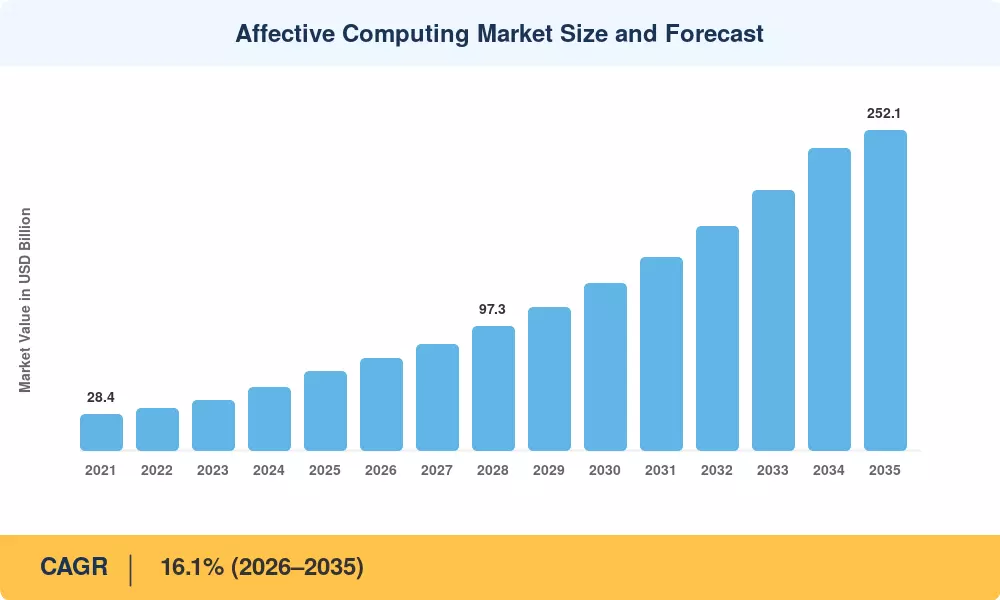
Affective Computing Market
Affective Computing Market is growing rapidly with AI-powered emotion recognition, human-machine interaction, and intelligent analytics.
The Affective Computing Market is redefining human-machine interaction by enabling AI systems to recognize, interpret, and respond to human emotions with greater intelligence and empathy.”
BERLIN, BERLIN, GERMANY, August 7, 2026 /EINPresswire.com/ -- Affective computing is reshaping how machines read and respond to human emotion, moving well beyond novelty chatbots and into safety-critical, clinical, and enterprise-grade systems. By fusing facial-expression analysis, vocal tone processing, physiological sensing, and natural language understanding, affective computing platforms let software infer frustration, stress, engagement, or fatigue in real time and adjust their behavior accordingly. Automakers, healthcare providers, contact centers, and consumer device makers are all racing to embed this capability, pushing the technology from research labs into everyday products.— Market Research Future
The global Affective Computing Market stood at an estimated USD 62.2 Billion in 2025 and is on track to climb from roughly USD 72.2 Billion in 2026 to about USD 252.1 Billion by 2035, expanding at a CAGR of 16.1% across the forecast window. This pace reflects a structural shift toward emotion-aware AI systems capable of interpreting human affective states in real time. Sustained public research funding, including large annual commitments from the U.S. National Science Foundation toward human-centered AI and the European Union's multibillion-euro Horizon Europe program for trustworthy AI, is reinforcing private-sector momentum. Meanwhile, global corporate spending on customer-experience technology that increasingly embeds sentiment analysis and emotion-aware interfaces has already crossed the several-hundred-billion-dollar mark, underscoring the scale of commercial demand pulling affective computing forward.
Static, survey-based feedback tools give way to multimodal systems that blend facial cues, voice patterns, physiological signals, and text sentiment into a single emotion-inference engine. This shift is especially pronounced in the automotive sector, where in-cabin driver-monitoring systems that gauge emotional and physiological state became a regulatory requirement across the EU starting in mid-2024, prompting billions of dollars in automaker investment in in-cabin sensing between 2022 and 2024.
Get a Sample PDF of the Report at -
https://www.marketresearchfuture.com/sample_request/6132
Market Dynamics: Drivers, Restraints and Opportunities
Growth in the Affective Computing Market is anchored by several converging forces. Regulatory mandates for in-cabin driver monitoring, most notably the EU's General Safety Regulation, have created a non-discretionary hardware and software market worth billions of euros across European automakers alone, while Euro NCAP's safety-rating incentives are pulling adoption into markets such as South Korea and Australia that reference NCAP benchmarks. The rise of generative AI and multimodal foundation models is also lowering the cost of building emotion-aware applications; industry estimates suggest the cost of training a production-grade emotion classifier fell by roughly three-quarters between 2021 and 2024, opening the door for smaller vendors to enter the space.
Healthcare is another major catalyst. Expanded regulatory pathways for AI-driven mental health monitoring devices in the United States have streamlined clearance for digital therapeutics, and platforms are increasingly weaving real-time vocal and facial affect tracking into cognitive behavioral therapy tools. On the enterprise side, contact centers handling hundreds of billions of customer interactions annually are turning to emotion AI to lift first-call resolution and curb churn, sustaining procurement budgets even when broader IT spending tightens.
Even so, the market faces meaningful headwinds. The EU AI Act classifies real-time emotion recognition in workplaces and schools as high-risk, adding substantial compliance costs, while U.S. state-level biometric privacy statutes have already generated hundreds of millions of dollars in settlements and created a fragmented compliance landscape. Algorithmic bias is a further concern: independent testing has repeatedly found accuracy gaps of ten to fifteen percentage points across demographic groups in commercial facial emotion recognition systems, prompting some municipalities to restrict government use of the technology. Integration complexity compounds these challenges, as many enterprises cite difficulty connecting emotion AI modules to legacy CRM, EHR, and human-machine-interface systems as their top adoption barrier.
These constraints are also opening new opportunities. Aging societies in Japan and South Korea are funding robotic caregiving platforms that read emotional and physiological cues to support elder wellbeing, while adaptive learning platforms that adjust pacing and content based on learner affect represent a multibillion-dollar addressable opportunity by the end of the decade. Emerging digital infrastructure build-outs in India and Southeast Asia are positioning those regions for a wave of affective computing adoption later in the forecast period, particularly within large voice-driven business process outsourcing operations. Automakers are also extending affective sensing beyond safety into full occupant-experience personalization, an expansion that can multiply the addressable technology content per vehicle several times over.
Key Players and Competitive Insights
The competitive landscape remains moderately fragmented, with the leading five companies collectively controlling roughly a third of global revenue and the remainder spread across specialized startups, academic spinoffs, and divisions of larger technology conglomerates. Cloud hyperscalers are increasingly embedding baseline emotion-recognition features directly into their platforms, which is compressing margins for standalone point-solution vendors and pushing smaller players toward vertical specialization.
Prominent participants in the global Affective Computing Market include Microsoft, Google, IBM, Smart Eye (which now incorporates Affectiva), Tobii, Seeing Machines, Cogito, Realeyes, Elliptic Labs, and Beyond Verbal (Vocalis Health), alongside a growing roster of emotion-AI startups. Microsoft and Google are positioning themselves as platform integrators, bundling emotional APIs into broader enterprise cloud and AI Cognitive Services offerings, while IBM emphasizes trust and compliance-oriented tooling. Smart Eye and Seeing Machines have carved out automotive-safety specializations, and Tobii pairs eye-tracking hardware with attention-computing software for XR use cases. Continuous investment in model accuracy, bias mitigation, multimodal fusion, and regulatory-grade transparency remains the primary basis of competition across the field.
Buy this Premium Research Report at - https://www.marketresearchfuture.com/checkout?currency=one_user-USD&report_id=6132
Market Segmentations
By Application
● Emotion Recognition
● Sentiment Analysis
● Social Interactions
● Affective User Interfaces
By Technology
● Machine Learning
● Natural Language Processing
● Computer Vision
● Speech & Voice Analytics
● Biosensors & Physiological Sensing
● Gesture & Body Language Recognition
By Component
● Software
● Hardware
● Services
By End Use
● Healthcare
● Education
● Automotive
● Entertainment
● Retail & Customer Experience
● Government & Defense
By Region
● North America
● Europe
● Asia-Pacific
● South America
● Middle East & Africa
Regional Insights
North America leads the Affective Computing Market with close to 38% of global share in 2025, underpinned by a dense concentration of cloud hyperscalers, AI research labs, and enterprise software spending across the United States and Canada. The United States alone is estimated to generate around USD 19.5 Billion in 2025 revenue, supported by corporate AI budgets and federal research grants, while Canada's renewed national AI strategy is reinforcing Montreal and Toronto as deep-learning research hubs relevant to emotion recognition and conversational AI.
Europe holds roughly 28% of the global market, shaped heavily by the EU AI Act's high-risk classification of workplace emotion recognition and mandatory in-cabin driver-monitoring rules. Germany commands close to a quarter of regional share on the strength of its automotive OEM cluster, while the United Kingdom is expanding briskly on the back of national digital mental-health programs.
Asia-Pacific is the fastest-growing region, expanding at close to 19.4% CAGR through 2035 as China builds out smart-city infrastructure, Japan advances its Society 5.0 vision for elder-care robotics, and India's business process outsourcing sector adopts speech-based emotion analytics at scale. South America and the Middle East & Africa remain comparatively smaller but are seeing accelerating uptake, led by financial-services fraud analytics in Brazil and smart-government initiatives in the UAE and Saudi Arabia.
Browse A Full Report: (Including Full TOC, List Of Tables & Figures, and Chart) -- https://www.marketresearchfuture.com/reports/affective-computing-market-6132
Recent Developments
Vendors have been moving quickly to consolidate multimodal capability into unified platforms. Smart Eye announced an integration of its Interior Sensing platform with a leading mobile chipset to enable single-chip driver and occupant monitoring for upcoming model-year vehicles, while Microsoft expanded its Azure AI services to combine speech, facial, and text signals into one real-time emotion-inference API for enterprise developers. Apple has broadened mental-health sensing within watchOS, pairing heart-rate-variability-derived stress scores with on-device mood journaling across its large installed base of wearable users.
On the regulatory front, the European Commission finalized implementing guidance for the EU AI Act's high-risk classification of workplace emotion recognition, with compliance deadlines set for 2027. Seeing Machines secured a large multi-year supply agreement with a top global automaker for its driver-monitoring system, and Cogito Corp launched a coaching-analytics dashboard that scores contact-center agent empathy in real time. NIST also released updated benchmark testing that disaggregates emotion-classification accuracy by demographic group, establishing a widely referenced fairness standard for the industry.
Frequently Asked Questions (FAQs)
Q1. What is the expected growth of the Affective Computing Market?
The market is projected to grow at a CAGR of 16.1% from 2026 to 2035, reaching about USD 252.1 Billion by 2035.
Q2. What factors are driving the Affective Computing Market?
Regulatory driver-monitoring mandates, generative AI advances, mental health digital therapeutics, and enterprise customer-experience personalization are key growth drivers.
Q3. Which region dominates the Affective Computing Market?
North America currently leads with close to 38% of global share, driven by concentrated AI research and enterprise cloud spending.
Q4. What are the major challenges facing the market?
Data privacy regulation, algorithmic bias across demographic groups, and integration complexity with legacy systems remain key challenges.
Q5. Which technologies are commonly used in affective computing?
Machine learning, natural language processing, computer vision, speech and voice analytics, and physiological biosensing are widely used.
Q6. Who are the leading companies in the Affective Computing Market?
Major players include Microsoft, Google, IBM, Smart Eye, Tobii, Seeing Machines, Cogito, Realeyes, Elliptic Labs, and Beyond Verbal.
Q7. Which application segment is growing the fastest?
Healthcare and mental health monitoring is the fastest-growing application, expanding close to a 19.0% CAGR.
➤➤ Regional & Country-Level Reports by Market Research Future:
Europe Affective Computing Market -
https://www.marketresearchfuture.com/reports/europe-affective-computing-market-64754
Germany Affective Computing Market -
https://www.marketresearchfuture.com/reports/germany-affective-computing-market-64750
UK Affective Computing Market -
https://www.marketresearchfuture.com/reports/uk-affective-computing-market-64748
Italy Affective Computing Market -
https://www.marketresearchfuture.com/reports/italy-affective-computing-market-64753
Japan Affective Computing Market -
https://www.marketresearchfuture.com/reports/japan-affective-computing-market-64751
South Korea Affective Computing Market -
https://www.marketresearchfuture.com/reports/south-korea-affective-computing-market-64749
GCC Affective Computing Market -
https://www.marketresearchfuture.com/reports/gcc-affective-computing-market-64752
US Affective Computing Market -
https://www.marketresearchfuture.com/reports/us-affective-computing-market-15432
Sagar Kadam
Market Research Future
+ +1 628-258-0071
email us here
Legal Disclaimer:
EIN Presswire provides this news content "as is" without warranty of any kind. We do not accept any responsibility or liability for the accuracy, content, images, videos, licenses, completeness, legality, or reliability of the information contained in this article. If you have any complaints or copyright issues related to this article, kindly contact the author above.
