

Smart Bed Market Set to Hit USD 5.75 Billion by 2035 as Smart Sleep Technology Expands
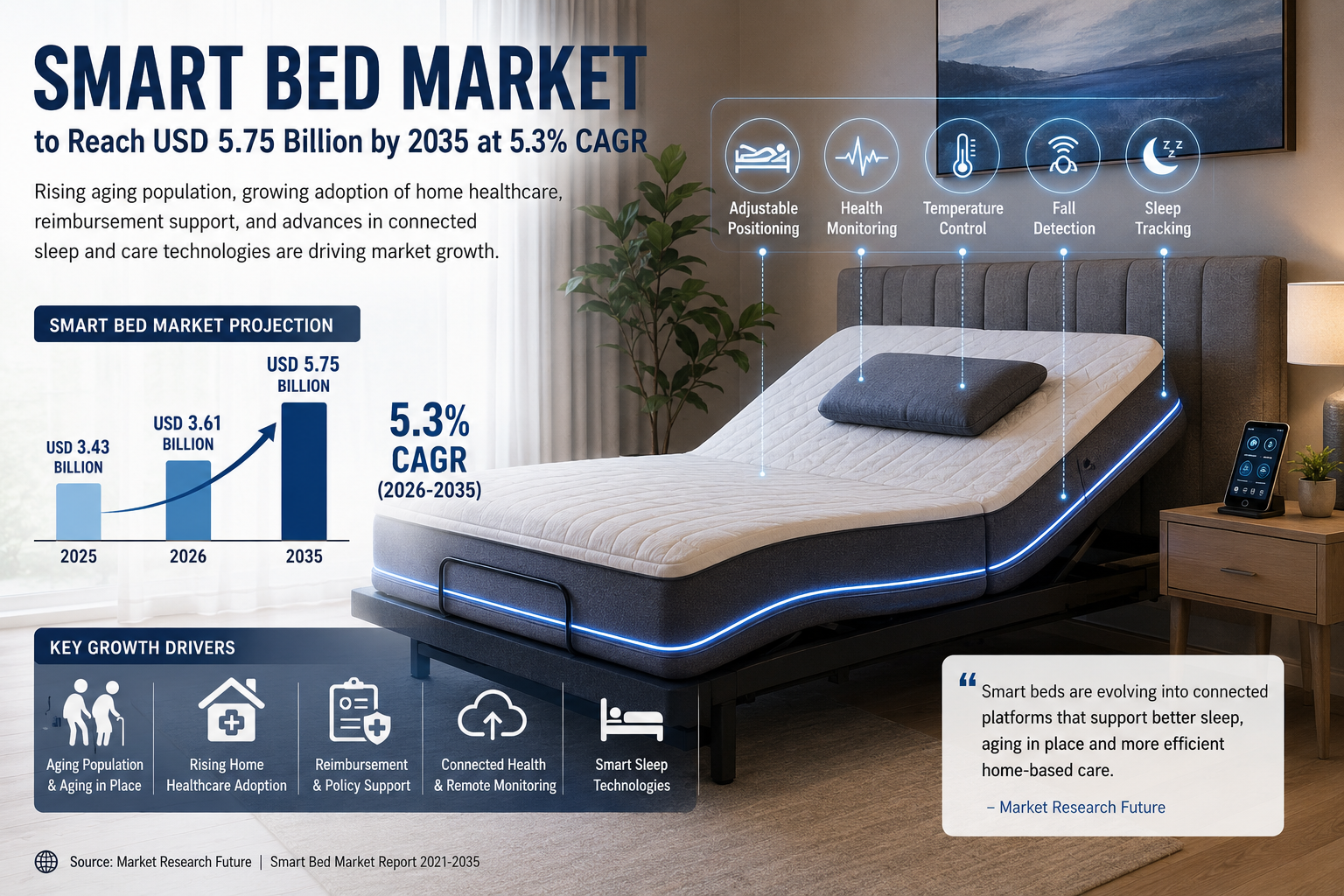
Smart Bed Market
Residential adoption, clinical applications and connected sleep technologies are reshaping the global smart bed industry through 2035.
Connected smart beds are creating new opportunities across home healthcare, remote monitoring and personalized patient care.”
NEW YORK, NY, UNITED STATES, August 28, 2026 /EINPresswire.com/ -- The global Smart Bed Market is entering a sustained period of expansion as consumers, healthcare providers, caregivers and hospitality operators increasingly adopt connected bed systems designed to improve sleep, comfort, mobility, monitoring and patient care. According to Market Research Future, the Smart Bed Market was valued at USD 3.43 billion in 2025 and is projected to increase to USD 3.61 billion in 2026, reaching USD 5.75 billion by 2035 at a 5.3% CAGR during the 2026–2035 forecast period.— Market Research Future (MRFR)
The market's trajectory reflects a broader convergence of sleep technology, home healthcare, aging-in-place preferences, connected-device adoption and clinical automation. Smart beds are increasingly moving beyond conventional adjustable furniture to incorporate electric positioning, biometric sensing, temperature management, sleep monitoring, pressure redistribution, fall detection, remote patient monitoring and software-enabled personalization.
Two structural catalysts are particularly important to the market's long-term outlook: demographic change and the expansion of home-based care. As populations age across developed economies, demand is increasing for products that allow older adults and people requiring assistance to remain safely and comfortably at home. At the same time, healthcare systems are placing greater emphasis on remote monitoring, preventive intervention and equipment that can support care outside traditional hospital environments.
Aging Population Creates Long-Term Demand for Smart Bed Technologies
Demographic change is emerging as one of the most significant forces influencing the Smart Bed Market. The expansion of the population aged 65 and above is increasing demand for home-care equipment, assisted-living technologies and products that support independent living.
Japan illustrates the strength of this trend. According to the Market Research Future market assessment, people aged over 65 represented 29.3% of the country's population in 2024, while its long-term-care insurance system can subsidize a substantial portion of rental costs for powered nursing beds for qualifying households. Germany has similarly established care-level-based equipment allowances that can facilitate access to powered care equipment.
These mechanisms are important because they can shift powered beds from discretionary purchases toward supported healthcare or long-term-care equipment. Such reimbursement and allowance structures can encourage replacement of manual frames with electric and sensor-enabled alternatives.
The broader aging-in-place movement is also changing consumer expectations. Older adults increasingly seek solutions that allow them to maintain independence while receiving support within familiar residential environments. Smart beds can contribute to this objective through adjustable positioning, remote monitoring capabilities, easier transfers, automated alerts and compatibility with broader connected-home ecosystems.
Get Full PDF Sample Copy of Report: (Including Full TOC, List of Tables & Figures, Chart) @ https://www.marketresearchfuture.com/sample_request/11619
Healthcare Applications Expand the Addressable Market
While residential consumers remain a major source of demand, healthcare applications are becoming increasingly important to the Smart Bed Market.
Modern clinical beds can incorporate features designed to address patient positioning, pressure management, mobility, fall prevention and monitoring. Hospitals and long-term-care facilities are increasingly evaluating equipment not only according to mechanical specifications but also according to its potential impact on clinical workflows and patient outcomes.
Pressure-injury prevention is one example. Smart and advanced care-bed platforms can integrate specialized surfaces, positioning capabilities and monitoring technologies intended to help caregivers manage patients at elevated risk. Automated positioning and pressure redistribution can potentially reduce manual workload while supporting standardized care protocols.
Connected beds can also provide information that may be relevant to remote patient monitoring and clinical decision-making. Sensors embedded in or integrated with the bed platform can monitor selected physiological or behavioral indicators, while connected software can transform raw signals into alerts, reports or trend information.
The Market Research Future assessment identifies remote physiologic monitoring as an important opportunity, particularly where connected sensing capabilities can be integrated into reimbursable clinical workflows. This creates a potential transition from a one-time equipment sale toward recurring technology and healthcare-service revenue.
Fully Electric Beds Remain a Key Product Segment
Product configuration remains an important differentiator within the market. According to Market Research Future, fully electric beds accounted for approximately 46.2% of the market in 2025, supported by demand for clinical repositioning, advanced functionality and premium consumer applications.
Fully electric platforms can provide automated adjustment of multiple bed functions, enabling users or caregivers to control positioning with greater precision. These systems are particularly relevant in clinical and home-care settings where frequent repositioning or assisted movement is required.
Semi-electric beds occupy an important mid-market position by combining powered adjustment for selected functions with manually operated components. They can provide a lower-cost entry point for healthcare facilities and home-care users that require some degree of powered positioning without the full functionality or price of a fully electric system.
Manual beds continue to serve price-sensitive applications, particularly in emerging markets, although the market is increasingly treating conventional platforms as an installed base that could eventually be upgraded through retrofit technologies.
Residential Demand Remains a Major Growth Engine
Residential applications represent a significant portion of the Smart Bed Market. Market Research Future estimates that the residential segment accounted for 58.7% of the market, reflecting strong consumer interest in sleep quality, comfort, adjustable positioning and age-in-place solutions.
Consumer smart beds are increasingly differentiated through features such as sleep tracking, automated firmness adjustment, temperature regulation and personalized sleep environments. Connected platforms can also link beds to smartphones, smart-home systems and subscription-based software services.
The consumer proposition is evolving from simply purchasing a mattress or adjustable foundation toward creating an integrated sleep environment. This shift allows manufacturers to develop recurring digital services alongside hardware sales, including personalized sleep insights, climate-control services and other software-enabled features.
However, the premium price of fully instrumented beds remains a market constraint. Market Research Future notes that fully electric instrumented beds can carry a substantial premium over conventional platforms in many retail markets. Financing programs, direct-to-consumer distribution and expanding consumer awareness of sleep technology are therefore expected to play important roles in adoption.
Smart Beds and the Growth of Connected Healthcare
The convergence of smart beds with digital health represents one of the market's most important technological developments.
Connected bed systems can collect information from pressure sensors, movement sensors, biometric monitoring technologies and other embedded components. When integrated with software platforms, this information can support sleep analysis, patient monitoring, automated alerts and personalized recommendations.
For healthcare providers, interoperability is becoming increasingly important. Hospitals want connected equipment to communicate with nurse-call systems, electronic health records and other digital infrastructure rather than operating as isolated devices.
Market Research Future identifies interoperability as a key consideration for institutional deployments, with standards-based approaches involving technologies such as HL7 FHIR and IEEE 11073 expected to become increasingly relevant. As healthcare facilities modernize their digital infrastructure, smart beds may become another connected endpoint within the broader clinical environment.
Data governance will also remain central to market development. Sleep-stage information, respiration measurements, heart-rate-related data and other health information can raise privacy and consent considerations. Manufacturers therefore face increasing pressure to establish transparent data ownership, consent, storage and deletion policies.
Asia-Pacific Emerges as a High-Growth Region
Regional dynamics are expected to significantly influence the global Smart Bed Market through 2035.
North America currently represents the largest regional market, with Market Research Future estimating a 38.4% share in 2025. Demand is supported by hospital capital renewal, consumer sleep technology and remote patient monitoring opportunities.
Europe represents another established market, supported by long-term-care infrastructure, medical-device regulation and government-backed care-equipment programs. Germany, the United Kingdom, France, Italy and Nordic countries each present distinct opportunities linked to elder care, healthcare modernization and home-care spending.
Asia-Pacific, however, is expected to record the fastest growth among major regions, with Market Research Future projecting a 7.1% CAGR from 2026 to 2035. The region benefits from expanding healthcare infrastructure, increasing urbanization, growing disposable incomes, rising awareness of digital health and the rapid development of elder-care systems.
Japan's long-term-care rental model is particularly significant because equipment rental can create shorter replacement cycles than conventional purchase-based markets. China is also investing in elder-care capacity, while India represents an emerging opportunity as private healthcare infrastructure and hospital capacity continue to develop.
Hospitality Creates a New Smart Bed Opportunity
The hospitality industry is opening another avenue for smart bed adoption.
Hotels and resorts increasingly compete on differentiated guest experiences, and connected sleep technologies can become part of that proposition. Smart beds can provide adjustable comfort, temperature management and personalized sleep environments while potentially generating anonymized or consent-based insights that improve the guest experience.
Premium hospitality properties may use smart beds as a technology-enabled amenity rather than simply a furniture upgrade. This creates opportunities for manufacturers to sell through business-to-business procurement channels and long-term refurbishment programs.
Hospitality demand can also help accelerate product innovation because hotel operators evaluate equipment based on durability, serviceability, guest satisfaction and total cost of ownership.
Retrofit Technologies Could Expand Market Penetration
A significant opportunity exists in upgrading the large installed base of conventional and semi-electric beds.
Replacing an entire bed can require substantial capital expenditure, particularly for hospitals and long-term-care operators managing hundreds or thousands of units. Retrofit solutions, including sensing mats, actuator modules and connected monitoring components, can provide an alternative pathway.
According to Market Research Future, approximately 61% of the global installed base consists of manual or semi-electric equipment with substantial remaining service life. Retrofit technologies could therefore allow operators to introduce selected smart capabilities without replacing entire platforms.
This approach may prove particularly valuable in cost-sensitive emerging markets, where the price premium associated with fully instrumented beds remains a barrier to adoption.
Technology Development Moves Toward On-Device Intelligence
The next stage of Smart Bed Market development is expected to involve greater use of artificial intelligence, embedded processing and edge computing.
Rather than transmitting every raw data point to cloud servers, manufacturers are increasingly exploring on-device processing that can classify sleep stages, detect bed exits and identify relevant events locally. Such architectures can potentially reduce latency, lower cloud-processing costs and limit the transmission of sensitive health information.
Over time, intelligence could become a core differentiator across both residential and clinical platforms. Beds may increasingly function as continuously operating health and wellness interfaces capable of responding automatically to user behavior.
Temperature regulation, firmness adjustment, sleep-stage detection, movement analysis and personalized positioning are among the capabilities that could become more tightly integrated.
Competitive Landscape Remains Diverse
The Smart Bed Market includes companies operating across consumer sleep, medical equipment, home healthcare, hospitality and component manufacturing.
Companies profiled in the Market Research Future market assessment include Sleep Number, Tempur Sealy, Baxter (Hillrom), Stryker, Paramount Bed, Arjo, Keeson Technology, Invacare, Serta Simmons, Eight Sleep and LINAK.
The competitive structure remains fragmented because consumer and clinical smart-bed markets have different purchasing criteria. Consumer brands generally compete through retail presence, sleep experience, financing, brand recognition and software-enabled personalization. Clinical suppliers compete through safety, clinical outcomes, interoperability, regulatory compliance, service networks and institutional procurement relationships.
This divergence creates opportunities for both established manufacturers and technology-focused entrants. Partnerships between mattress manufacturers, sensor companies, software developers and healthcare technology providers could become increasingly important as the market evolves.
Outlook Through 2035
The Smart Bed Market is positioned for sustained expansion as the boundaries between furniture, medical equipment, sleep technology and connected health continue to converge.
From a market value of USD 3.43 billion in 2025, the industry is expected to reach USD 3.61 billion in 2026 and approximately USD 5.75 billion by 2035, representing a 5.3% CAGR over the forecast period.
The opportunity extends beyond the sale of connected beds themselves. Manufacturers can develop recurring software services, remote monitoring solutions, retrofit technologies, data-enabled clinical tools and hospitality applications around the underlying hardware.
The strongest market participants are likely to be those capable of combining reliable mechanical platforms with sophisticated sensing, intuitive software, interoperability, strong service infrastructure and responsible data-management practices.
As healthcare systems continue moving toward home-based care, consumers prioritize sleep and wellness, and aging populations seek greater independence, smart beds are increasingly positioned as multifunctional platforms rather than conventional bedroom products.
The convergence of demographic demand, healthcare modernization, reimbursement opportunities, connected technology and consumer sleep awareness is expected to keep the Smart Bed Market on a steady growth path through 2035.
Discover Related Research Reports By Market Research Future:
Home Bedding Market
https://www.marketresearchfuture.com/reports/home-bedding-market-8790
Bed Linen Market
https://www.marketresearchfuture.com/reports/bed-linen-market-24197
Smart Fabric Market
https://www.marketresearchfuture.com/reports/smart-fabric-market-32946
Market Research Future
Market Research Future
+1 855-661-4441
email us here
Legal Disclaimer:
EIN Presswire provides this news content "as is" without warranty of any kind. We do not accept any responsibility or liability for the accuracy, content, images, videos, licenses, completeness, legality, or reliability of the information contained in this article. If you have any complaints or copyright issues related to this article, kindly contact the author above.
